Anal about
audio.
With audio analysis
Bad rips and fake files hide in every collection: fine on headphones, flat and lifeless on a big system. Audio Anal checks every record you own, flags the ones that will let you down, and heals drifting tempo across the whole crate in one pass. Scan for free. Heal when you’re ready.
Analysing your library, nothing uploaded
The rig always tells the truth.
Every DJ has done it. Loaded a track marked FLAC, dropped it on a system with real headroom, and watched the top end turn to static while the kick landed soft. Not a taste thing. Not an EQ thing. A 128kbps MP3 bounced into a FLAC or WAV, then re-encoded, retagged, "upgraded" and passed around as the real thing. Compression doesn't just shave the top off a file: it smears the attack of the kick and folds the bass toward mono. Punch on headphones, pillow on a sub.
And it isn't just the shared folders and old blog rips. Proper shops sell whatever the label uploads, and labels lose masters. That WAV you bought in good faith can be a bounce from an old MP3 premaster; that reissue can be a vinyl transfer sold as a remaster. Buying legit doesn't make you safe.
Then there are the bad vinyl rips: needle noise and subsonic rumble buried under a kick that shouldn't have any. Here's the thing: on headphones you might not hear any of it. The club system knows. Every frequency that file is missing is energy the room never gets. The top end goes brittle, the low end goes soft, and the detail that makes a record move a floor simply isn't there.
Bad tempo is the other one. A track that's "about 128" drifts: recorded off a deck with wow and flutter, stitched from two takes, exported through software that nudges the clock. Beatmatch it by ear and it slides. Beatgrid it in Rekordbox and the grid lies right along with it.
Your ears catch some of this. A big rig catches the rest, brutally, in front of a room. Audio Anal catches it before either of them has to.
Know the tells
Fake lossless: an MP3 in a FLAC file, hiding until the tweeters find it.
Soft low end: a smeared kick attack. Punch on headphones, pillow on a sub.
Smeared hats: cymbals go swishy and metallic, the classic low-bitrate giveaway.
Vinyl rip: rumble under the kick, hiss over the hats. A record, not a master.
Tempo drift: a BPM number that's true for four bars and false for the other sixty.
Analyse. Verdict. Heal, with your approval.
Point it at a folder, a drive, or your whole Rekordbox library. Only one of the three stages ever writes a file, and it never writes over yours.
Analyse: a full-file FFT
A Welch power-spectral-density pass over every track. Not a metadata check, a measurement. Codec, sample rate, bit depth, clipping, DC offset, silence and loudness read alongside it.
Verdict: in plain English
PASS, WARN, FAIL or ERROR, with a label that says what was actually found: LOSSLESS, LOSSY, FAKE LOSSLESS, LOW QUALITY, VINYL RIP?, CHECK. Every verdict earned by measurement, none guessed from a tag.
Heal: with your approval
Drifting tracks are beat-tracked and time-mapped flat with pitch-preserving processing. The healed copy lands in an "AudioAnal Healed" folder, tags and artwork carried across. Your original is never opened for writing.
It says FLAC. It sounds like 2009.
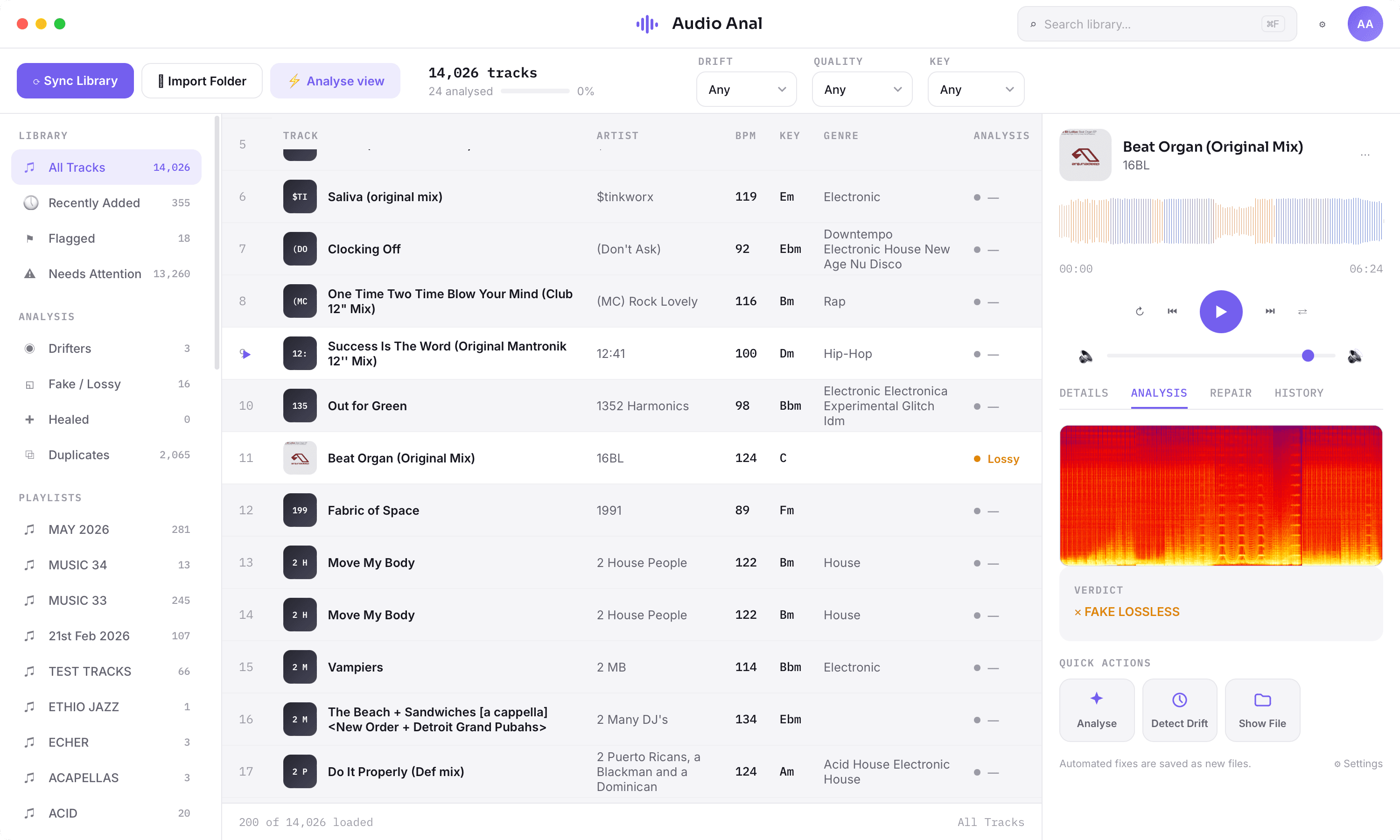
Lossy encoders throw the top of the spectrum away and leave a mark doing it: a brick-wall cliff, anywhere from 12 to 20kHz. Bounce that MP3 into a FLAC wrapper and the tag says lossless. The spectrum says otherwise. Audio Anal runs a Welch PSD across the whole file and reports the exact frequency the story falls apart. It knows a mastering filter from an encoder, so a genuine master that rolls off at 21kHz isn’t called a fake.
Your 124 wasn't always 124.
Instead of one averaged BPM, Audio Anal builds a per-window tempo time series (spectral-flux onsets, 8-second windows, autocorrelation) and scores two things: the wobble, and the slow wander a live drummer leaves in a record. A track that creeps a few BPM over six minutes gets caught even when every eight-second slice looks steady. Healing beat-tracks the drift and stretches it flat without touching the pitch.
Healed with rubberband --fine. Pitch preserved. Original untouched; the new file is written to AudioAnal Healed.
This is the actual software.
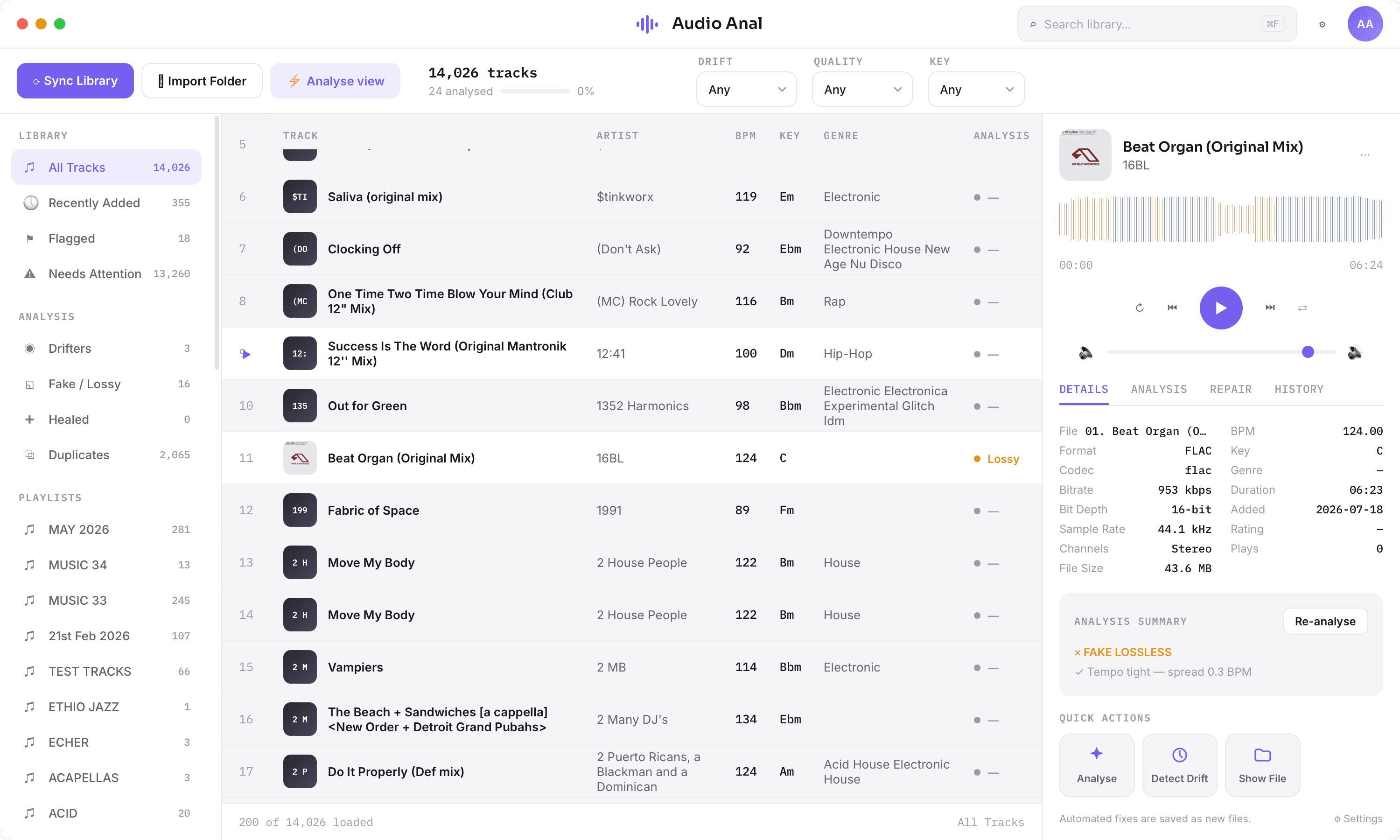
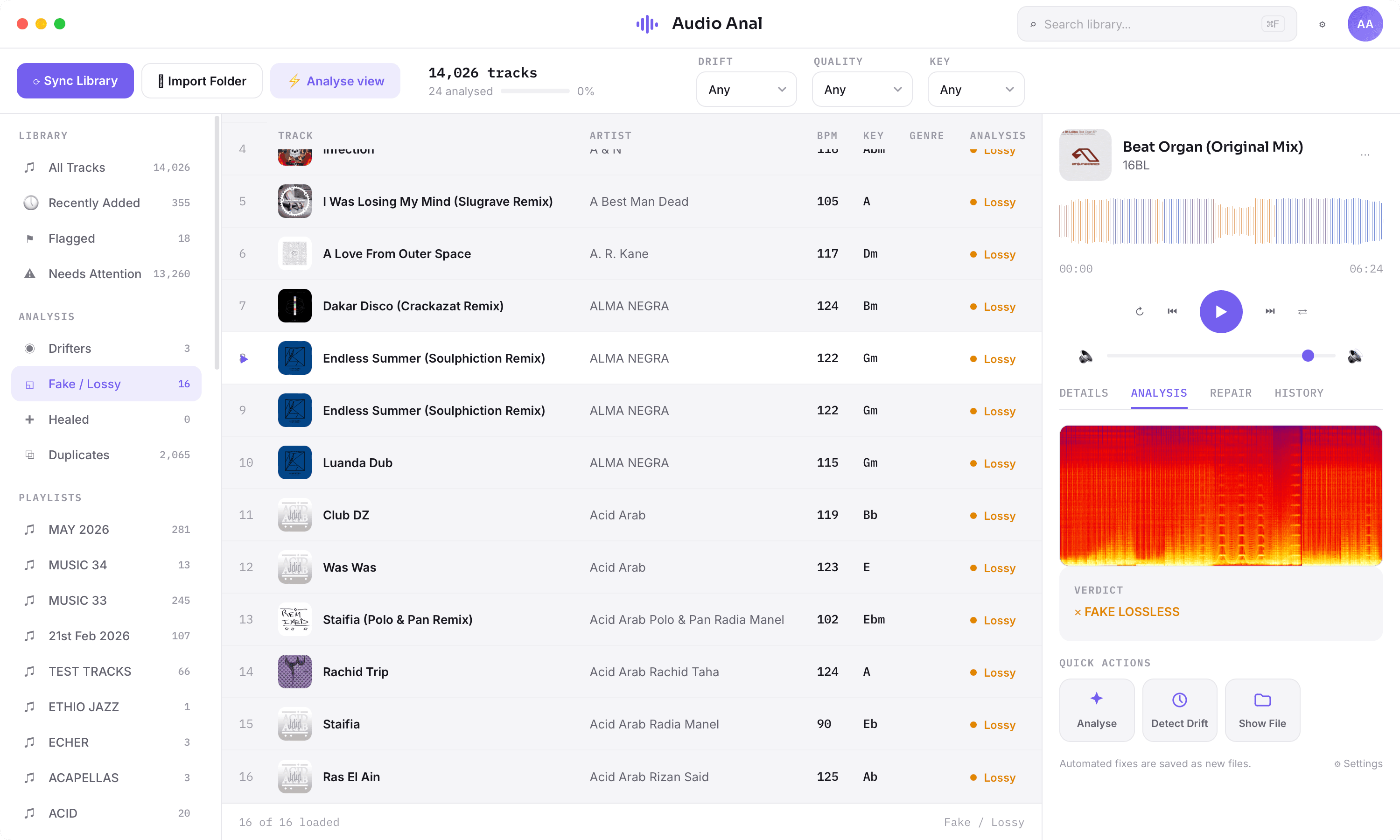
Not a mock-up. Audio Anal running over a real 14,000-track rekordbox library: three MP3s dressed as FLACs caught on the first screen, verdicts written into the analysis column, one click to queue the rest.
One table. Every file.
Run it over a crate and you get a verdict table, not a vibe. Codec and container from ffprobe, sample rate and bit depth against a 44.1kHz/16-bit profile, clipping at 0dBFS, DC offset, silence, loudness as LUFS, LRA and true peak. Reported, never guessed. Files that won't decode aren't skipped quietly. They're marked ERROR and put in front of you.
0 files analysed
Nightbus Radio
Fenlow
Cassette Weather
Marl & Ostro
Warehouse Static (Original Mix)
Dunmore
Low Tide Return
K. Sennet
Glass Corridor
Verje
Untitled Session 4
Hallow Deck
"The room told him what the files were."
Audio Anal was built by the owner of Faith In Strangers, a venue in Margate with a custom-built Poseidon sound system, a rig designed to reproduce a full room of frequency rather than flatter it. A system like that doesn't round anything off. It plays a bad transcode exactly as badly as it deserves, at volume, in front of a dancefloor.
After enough nights of hearing "lossless" downloads fall apart above 15kHz and beatgrids wrestle drifting rips, the obvious fix wasn't a better ear. It was an FFT. So he built the tool that listens the way the room does, before the track ever reaches the booth.
Built for the rig, by someone who plays out on one.
Faith In Strangers, Margate. Poseidon sound system.
Your music stays on your computer.
Every measurement and every heal runs on your Mac. There is no upload step, no cloud analysis and no account. The app only goes online to activate a licence and to check for updates, and neither sends a single note of your music. ffmpeg and Rubber Band are bundled inside the app, so you install nothing else.
Analysed on your Mac
No uploads
No account
£79. Launch price £49.
Analyse your entire library for free. Pay only when you’re ready to heal it: one payment, yours for good.
- Scan your entire library, no limit
- PASS / WARN / FAIL / ERROR on every file
- Fake-lossless detection (spectral cutoff)
- Tempo-drift measurement (tight / watch / DRIFTS)
- Spectrograms, waveforms and drift maps
- Read-only Rekordbox sync
- Tempo-drift healing, pitch preserved
- Non-destructive healed copies, complete undo
- Originals never touched, by design
- Batch processing, unlimited tracks
- Before-and-after report on every heal
- Use it on two Macs
- Lifetime updates included
- No subscription; works offline once activated
One-off payment in pounds sterling, with a 14-day money-back guarantee. Needs a Mac with Apple silicon (M1 or later) running macOS 14 Sonoma or later.
Before you ask.
Point it at your library.
Download the analyser and aim it at the folder you’re least sure about. Scanning is free forever. When you’re ready to heal the drifters and batch the whole library,it’s £49 for the first 200 licences, then £79.Once, and it’s yours.
No account and no mailing list. Mac with Apple silicon, macOS 14 or later.
For Macs with Apple silicon on macOS 14 or later; Windows is planned. Reads around two dozen formats via ffmpeg. Your music never leaves your Mac.
© 2026 Leave Only What Matters Ltd, registered in England and Wales, company number 17231249. Registered office: 17 Ethelbert Crescent, Margate, CT9 2DY.